

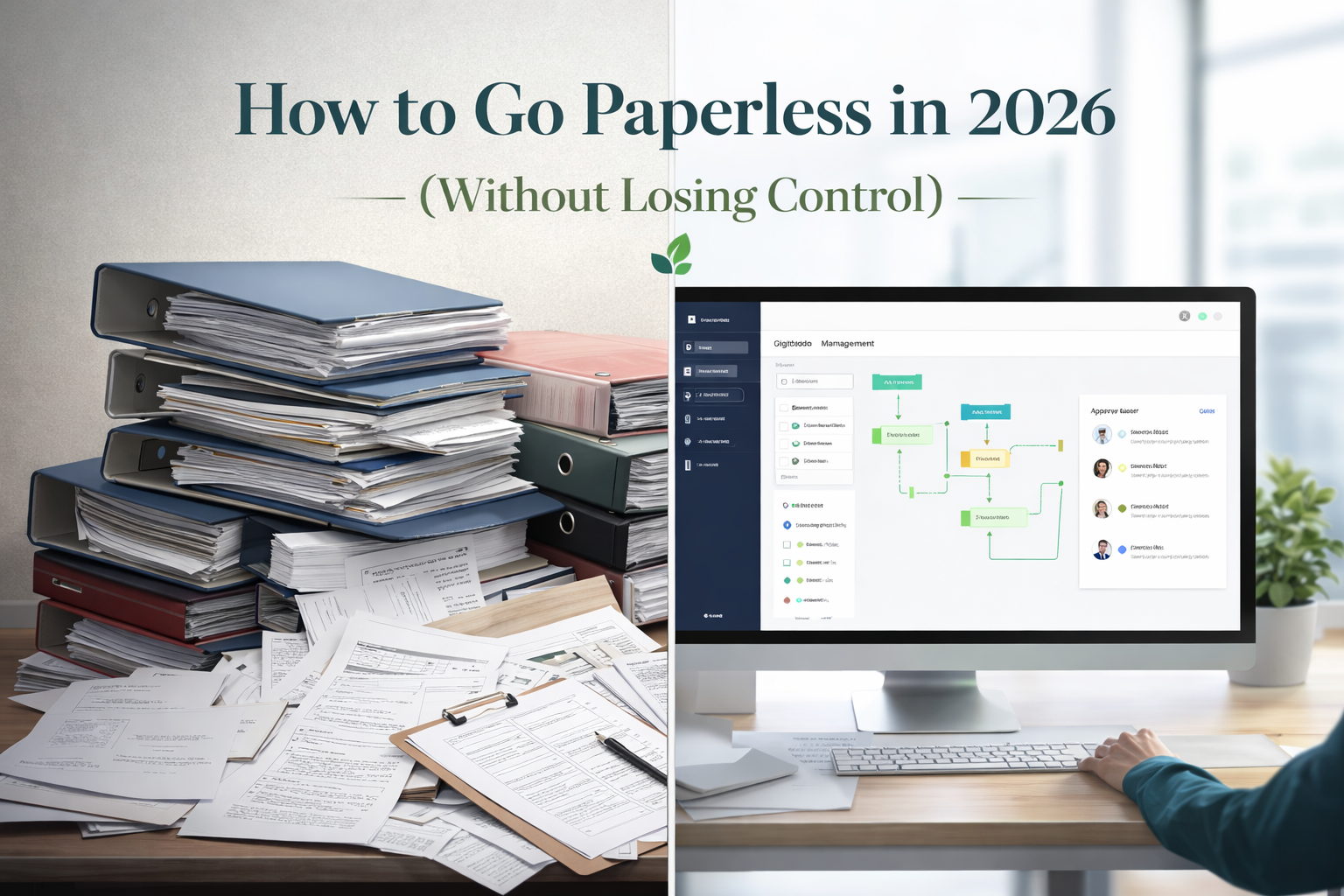
Imagine walking into an office and seeing 40 to 50 registers neatly stacked across desks and cabinets.
For many organizations, this represents discipline, recordkeeping, and compliance. Paper has supported operations reliably for decades.
Now the question is not whether paper is wrong. The question is whether digital systems can complement or improve how documentation is managed today.
In many cases, they can.
Why Paper Has Been the Default
1. “The process requires it.”
Processes require compliance and documentation. Traditionally, paper has been the most accessible way to achieve that.
Today, digital workflows can meet the same compliance requirements while offering greater visibility and structured tracking. If a workflow has not yet been digitized, it may simply require careful redesign and stakeholder alignment.
That transition does require planning, training, and change management. It is not just a technology shift. It is a process shift.
2. “We need physical logs for audits.”
Auditors focus on traceability and process adherence. They typically look for:
- Who approved what
- When it was approved
- Whether procedures were followed
A structured digital system can provide time-stamped logs, approval trails, and searchable records. This can simplify audit preparation and reduce retrieval time.
However, organizations must ensure proper access controls, data backup policies, and documentation standards before making the shift. Audit readiness depends on implementation quality, not format alone.
3. “Quality standards require documented records.”
Standards such as ISO require controlled documentation and secure recordkeeping.
They do not mandate a specific medium.
Digital documentation can support:
- Controlled processes
- Version management
- Access permissions
- Secure storage
The key is ensuring the system is validated, consistently used, and properly governed.
Reframing Paper and Digital Workflows
Reframing Paper and Digital Workflows
Control
Consider a gate pass workflow.
With paper:
- Entries are manually recorded
- Approvals are written and signed
- Records are physically stored
With digital workflows:
- Approvals follow structured sequences
- Every action is time-stamped
- Records are centrally stored and retrievable
Digital systems can enhance oversight, provided the process is clearly defined and adoption is enforced.
Efficiency
Physical registers are straightforward and familiar. However, retrieving historical records or generating reports can require time and manual effort.
Digital systems allow:
- Instant search
- Real-time tracking
- Automated notifications
- Centralized dashboards
This improves response time and reporting accuracy.
The challenge lies in training teams and ensuring consistent data entry practices. Without discipline, even digital systems can become fragmented.
Cost and Security
Physical records involve storage space, archiving procedures, and manual handling.
Digital systems reduce physical storage needs and simplify retrieval. They also introduce new responsibilities such as cybersecurity, backup management, and access governance.
A successful transition requires addressing both operational and IT risks thoughtfully.
A Light Reminder From Yes Minister
In the classic British sitcom Yes Minister, there is an episode about reducing paperwork.
The solution was to photocopy everything before shredding it.
It is satire, but it reflects a common scenario. Organizations sometimes run paper and digital systems in parallel for extended periods. While this feels safer, it can increase duplication and workload.
Effective transition means redesigning processes intentionally rather than layering systems on top of each other.
How to Transition to a Paperless Office Smoothly
1. Start with a Pilot
Choose one controlled process and digitize it fully.
Monitor compliance, adoption, and efficiency metrics before scaling. A phased rollout reduces disruption and builds internal confidence.
2. Prioritize High-Impact Workflows
Focus on areas such as:
- Asset Management
- Material Gate Pass Management
- Checklists
- Quality documentation
- Audit trails
These processes benefit significantly from structured traceability.
For a structured roadmap, refer to:
→ [Step-by-Step Guide to Digitizing Operational Workflows]
3. Update Documentation Policies
Review your SOPs and define:
- Digital record retention policies
- Role-based access controls
- Audit retrieval procedures
- Backup and disaster recovery plans
Policy alignment is essential before scaling digital documentation across the organization.
The Role of Technology in a Paperless Organization
Modern workflow platforms are designed to support compliance-focused digitization. The right system should provide:
- Secure data storage
- End-to-end traceability
- Time-stamped approvals
- Easy retrieval and reporting
- Automated compliance logs
Organizations that implement structured digital workflows often report significant reductions in paper usage while improving process visibility.
Why Consider the Shift Now?
Moving toward a paper-reduced or paper-optimized office is not about rejecting traditional methods. It is about evaluating where digital tools can enhance:
- Compliance visibility
- Audit readiness
- Operational efficiency
- Cost control
- Environmental responsibility
Many organizations will continue using paper for certain processes. The opportunity lies in identifying where digital systems add measurable value.
Ready to Explore the Transition?
If you are evaluating a more digital documentation strategy:
- Map existing paper-based workflows
- Identify two or three processes suitable for digitization
- Assess technology platforms that support structured compliance
Book a demo to understand how structured digital workflows can reduce manual documentation while strengthening control and transparency.
The goal is not to eliminate paper entirely.
The goal is to use the right system for the right process.